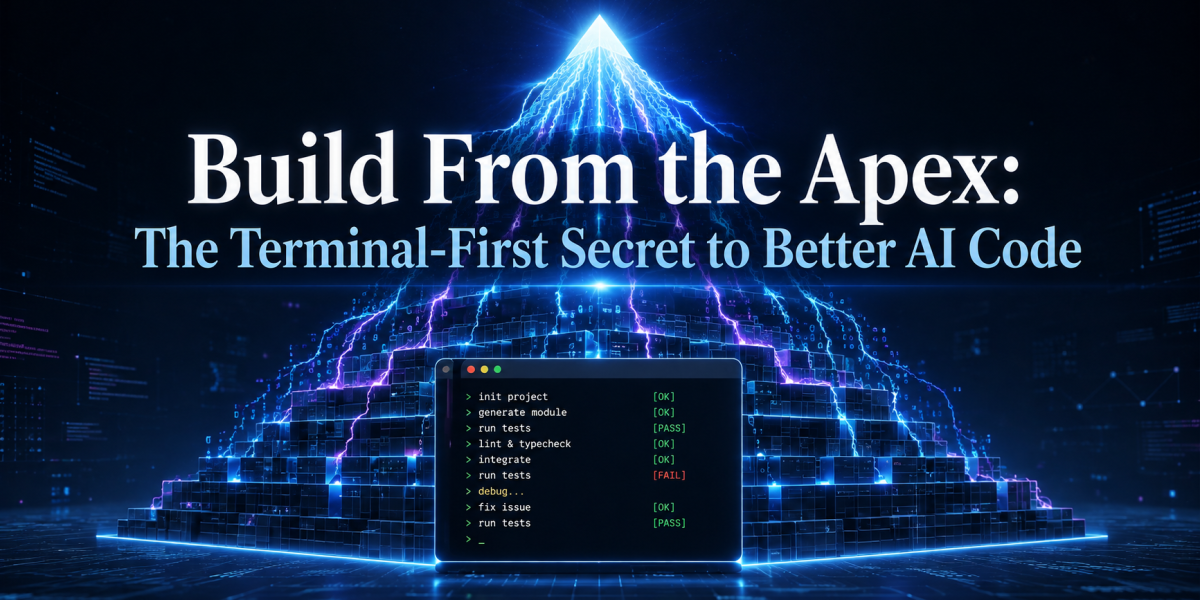
Build From the Apex: The Terminal-First Secret to Better AI Code
The best AI-generated code does not come from writing one perfect prompt and walking away.
It comes from sitting at the terminal and saying:
Build.
Run it.
Watch it fail.
Explain what failed.
Build again.
Test it.
Feed the result back into the system.
Build again.
Over and over, until what started as an idea becomes something that can actually stand on its own.
I think of AI-assisted software development as constructing a pyramid from the apex downward.
You begin with a single point: the objective.
From that point, computation starts shooting outward like lightning.
One branch becomes an API. Another becomes a database migration. Another becomes authentication. Another becomes a test suite. Another becomes a deployment script. Some of those branches work. Some collapse. Some reveal problems you could never have predicted from the original prompt.
So you return to the apex.
Here is the objective. Here is what exists. Here is what broke. Build.
The lightning fires again.
Eventually those individual paths begin connecting with one another. Tests start passing. Interfaces stabilize. Edge cases disappear. Architecture becomes clearer.
The pyramid starts standing.
AI Coding Is an Iterative Process, Not a Prompting Contest
There is an obsession with finding the perfect AI prompt.
I think that misses something important.
For serious software, the most valuable interaction with an AI coding system is often not the first prompt. It is the 50th command after the AI has already seen the code, the errors, the architecture, the tests, the logs, and the consequences of its previous decisions.
That feedback loop is where the quality comes from.
You tell it:
This endpoint is returning the wrong object.
Fix it.
Then:
That fixed the endpoint, but now this test fails.
Fix it.
Then:
Good. Now run the entire test suite.
Then:
Three failures remain. Understand why before changing anything.
Then:
Build.
Each pass adds more information about the actual system.
The AI is no longer reasoning only from your abstract description of what you want. It is reasoning from the living evidence produced by the software itself.
That distinction is enormous.
Keep the AI Close to the Machine
This is why I increasingly believe the terminal is one of the most powerful places to work with AI.
The terminal exposes reality.
The application either starts or it doesn’t.
The tests either pass or they don’t.
The package installs or it fails.
The database accepts the migration or rejects it.
The server returns 200, 404, or 500.
There is very little room for pretending.
When the AI can repeatedly inspect those results, make a change, run the command again, inspect the consequences, and continue, development becomes a closed feedback loop.
Intent → Code → Execution → Evidence → Correction → Execution.
Repeat.
That is where clean systems emerge.
Keep Building While the Context Is Hot
There is another important part of this process:
When you have a productive AI coding session going, keep going.
Do as much coherent work as you reasonably can in that pass.
Not because you are literally retraining the underlying neural network every time you type a command. In most AI coding systems, you are not changing the model’s permanent weights.
What you are doing is building an increasingly information-rich working context.
The AI has now seen:
- your directory structure
- your naming conventions
- your architecture
- your database schema
- your existing abstractions
- your mistakes
- its own mistakes
- your corrections
- your tests
- your deployment environment
- your expectations
The longer that coherent feedback loop remains intact, the less the AI has to guess.
I think of that state as charging the context.
At the beginning of a session, the AI may understand the general technology.
After enough interaction, it begins understanding your particular system.
That is when it becomes dramatically more useful.
Errors Are Fuel
Traditional programming teaches us to hate errors.
AI-assisted programming changes the relationship.
An error is information.
A stack trace is information.
A failed test is information.
A screenshot is information.
A performance regression is information.
A strange response from an API is information.
Every time the system produces evidence, feed that evidence back into the reasoning loop.
Don’t simply say:
“It doesn’t work.”
Say:
“I ran this command. Here is the output. This is what I expected. This is what happened instead. Find the cause. Fix it. Run it again.”
That is an extraordinarily powerful development pattern.
The software itself becomes part of the conversation.
Don’t Build the Entire Pyramid in Your Head
Humans traditionally try to reason downward:
First design everything.
Then architect everything.
Then build everything.
AI makes another pattern possible.
Start with the apex.
Define the outcome clearly.
Then allow the implementation to expand downward through repeated experimentation, testing, correction, and refinement.
You still need architecture.
You still need judgment.
You still need security reviews, tests, code review, and experienced engineers.
But you don’t necessarily need to predict every branch before the first line of code is written.
You can discover the structure through execution.
Build. Run. Observe. Correct. Build again.
Eventually the architecture reveals itself through the constraints of the real system.
The Pyramid Must Stand
This is the part that matters most.
AI can generate enormous amounts of code.
That alone means almost nothing.
The goal is not code generation.
The goal is a system that stands.
A system where the frontend talks correctly to the backend.
Where the backend talks correctly to the database.
Where authentication actually protects what it is supposed to protect.
Where tests reproduce the behavior you expect.
Where deployment works.
Where failures are understandable.
Where another engineer can open the repository and make sense of what happened.
Every bolt of lightning eventually has to connect to something structural.
Otherwise you don’t have a pyramid.
You have sparks.
The Secret to Better AI Products
I believe one of the secrets to building genuinely good AI-powered software is surprisingly simple:
Stay in the loop.
Stay at the terminal.
Keep giving the AI reality.
Keep making it execute.
Keep showing it the consequences.
Keep asking it to inspect its own work.
Keep pushing from the same apex:
What are we trying to build?
Then:
Build.
Again.
Build.
Again.
Build.
Until the lightning has traveled all the way down.
Until the pieces connect.
Until the errors have been absorbed into the design.
Until the foundation exists.
Until the pyramid can stand without you holding it up.
That is when AI stops being a code generator.
It becomes a development process.