The New Business Asset: Self-Emphasis, AI, and the Connection of the Vibe
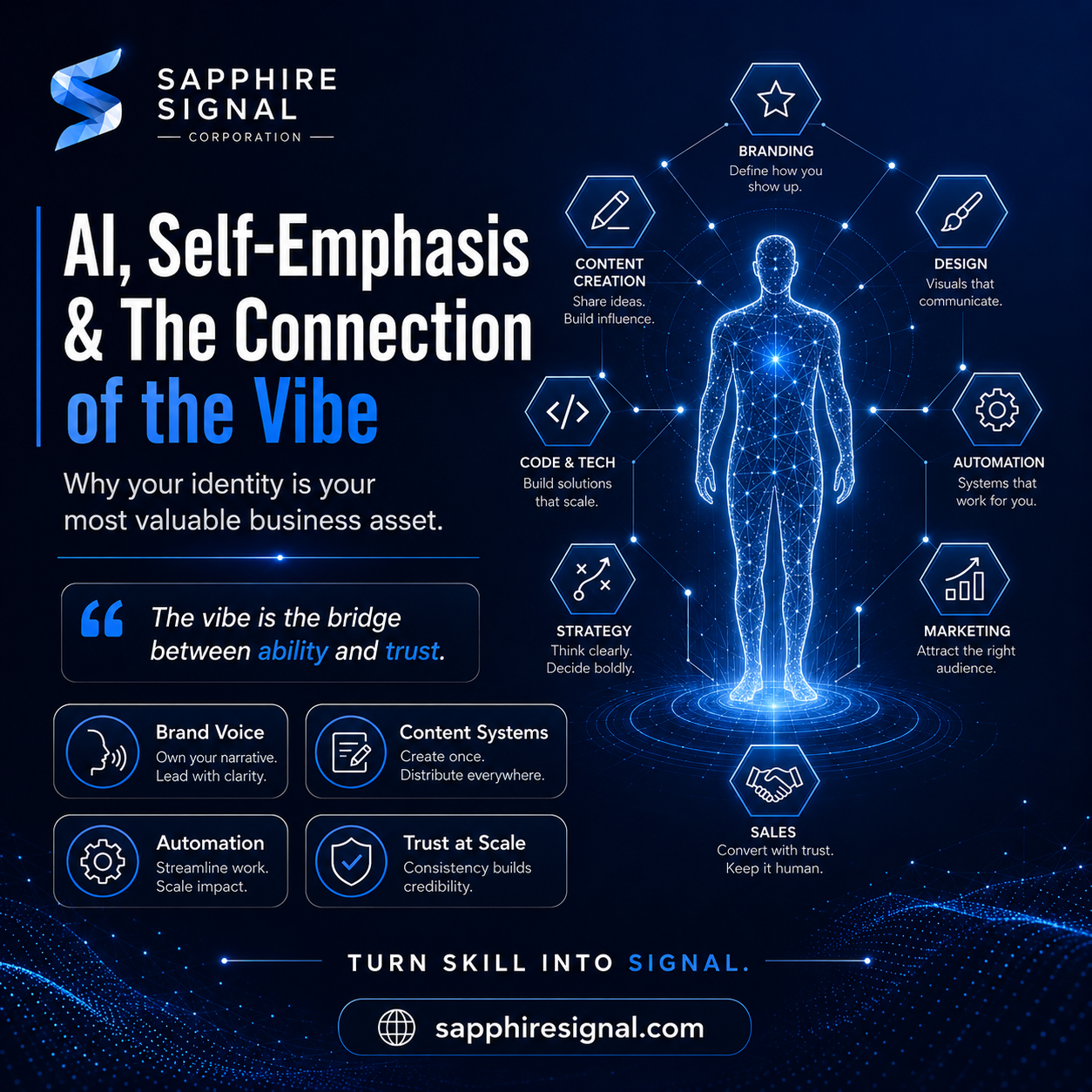
For a long time, business branding was treated like a costume. You picked colors. You wrote a mission statement. You designed a logo. You printed the business cards. Then you hoped the market understood what you were trying to become.
AI changes that.
Today’s AI tools allow a founder, freelancer, consultant, artist, or technical operator to emphasize the self more clearly, more consistently, and more powerfully than ever before. Not in a shallow “look at me” way, but in a strategic way: the self becomes the signal. The business becomes an extension of the person’s taste, energy, worldview, technical ability, and execution style.
That is what I call the connection of the vibe.
The vibe is not just aesthetics. It is the emotional logic behind the brand. It is the reason someone feels, “This person gets it.” It is the atmosphere created by your words, designs, offers, music, code, portfolio, social posts, and client experience. AI tools now make it possible to turn that vibe into a repeatable business system.
AI Lets the Individual Become the Brand Engine
In the old model, a person needed separate specialists for almost everything: a copywriter, a designer, a strategist, a developer, a marketer, a video editor, a sales assistant, and a brand consultant. That structure still has value, especially at scale, but AI gives individuals the ability to prototype all of those functions themselves.
A founder can now write a pitch, design a campaign, generate brand visuals, draft sales emails, organize product descriptions, build landing page copy, analyze customer objections, and create a personal content engine from one central idea. OpenAI’s custom GPT tools, for example, let users create assistants with specific instructions, knowledge, capabilities, and actions, which means a business can start shaping AI around its own operating style instead of treating AI as a generic chatbot. (OpenAI Help Center)
That means the founder’s identity, perspective, and instincts can become structured. Instead of the business losing personality as it grows, AI can help preserve the personality.
The brand no longer has to sound like “a company.”
It can sound like the person behind the company, sharpened into a system.
The Most Valuable Asset Is Not Just Attention — It Is Resonance
Attention is valuable, but attention alone is unstable. A viral post can bring traffic and still fail to create trust. A flashy logo can impress people and still fail to communicate depth.
The deeper asset is resonance.
Resonance happens when the external message matches the internal truth. The business feels aligned. The visuals match the offer. The language matches the founder. The pitch matches the actual ability. The vibe matches the execution.
AI helps create resonance because it allows constant iteration. You can test ten versions of a headline. You can turn a resume into a rap song. You can turn a technical skillset into a visual campaign. You can turn a vague business feeling into a repeatable content style. You can take the raw self and refine it until it becomes legible to the market.
That is self-emphasis in business: not ego for ego’s sake, but clarity of identity as a commercial advantage.
Example 1: The Developer as the Product
Take a senior full-stack developer who knows Laravel, PHP, LAMP, React, Node.js, Magento, Shopify Plus, AWS, CI/CD, Stripe integrations, and performance optimization. Traditionally, that person might just have a resume and a portfolio.
With AI, that same developer can turn their skillset into an ecosystem:
A LinkedIn banner that communicates technical authority.
A square post graphic offering 20 free consulting hours.
A rap song that turns the resume into rhythm.
A SoundCloud cover with a dragon coding at a computer.
A sales email aimed at eCommerce companies.
A technical audit checklist.
A landing page offering AI automation and modernization.
A proposal template for Shopify, Magento, or WordPress clients.
The same technical skillset becomes multiple expressions of the same identity. The code becomes content. The resume becomes marketing. The portfolio becomes mythology. The offer becomes a signal.
That is the vibe becoming a business asset.
Example 2: The eCommerce Brand With a Personality
AI is especially powerful in eCommerce because products need stories. A plain product page says what something is. A strong product page says why it matters.
Shopify Magic can generate product descriptions from details like product titles and keywords, and Shopify describes it as AI features integrated across workflows for store building, marketing, customer support, and back-office management. (Shopify Help Center)
But the real opportunity is not just generating descriptions faster. The real opportunity is making every description sound like the brand.
A streetwear brand can sound rebellious.
A luxury skincare brand can sound calm and elegant.
A spiritual brand can sound symbolic and transformative.
A developer tools brand can sound sharp, technical, and efficient.
AI can take the “vibe” of the founder and apply it across hundreds of product pages, emails, ads, support responses, and social posts. The result is consistency without emotional flatness.
Example 3: The Brand Kit as a Vibe Container
Design tools are also moving in this direction. Canva’s Brand Kit helps users organize logos, colors, fonts, and brand assets, while Canva’s AI tools emphasize creating on-brand designs and applying brand assets automatically. (Canva)
This matters because visual consistency used to require strong design discipline. Now, the founder can define the visual identity once, then use AI-assisted tools to keep producing aligned assets.
The brand kit becomes more than a folder. It becomes a container for the vibe.
For example, a company like Sapphire Signal Corporation might define its world as sapphire blue, signal waves, automation, high-performance systems, AI-assisted software development, and enterprise modernization. Once that world is clear, AI can help produce LinkedIn banners, pitch decks, website sections, social images, lead magnets, video thumbnails, and proposal graphics that all feel connected.
The vibe becomes scalable.
Example 4: Sales and Marketing That Sound Human Again
One of the strange things about business is that companies often remove the very personality that made people interested in the first place. They become polished but forgettable. Professional but lifeless.
AI can either make this worse or solve it.
Used lazily, AI creates generic content. Used correctly, AI becomes a mirror and amplifier. It can study your language, your offers, your values, your strongest stories, your best case studies, and your real client outcomes. Then it can help you communicate with more precision.
HubSpot describes its platform as connecting marketing, sales, service, and CRM software, with AI integrated into a broader customer platform. (hubspot.com) That points to the larger business trend: AI is not only about content creation anymore. It is about connecting the message, the customer data, the sales process, and the follow-up.
For a small business, this means the founder’s voice can travel through the entire pipeline:
The first LinkedIn post.
The first email.
The landing page.
The sales call notes.
The proposal.
The onboarding message.
The follow-up campaign.
When all of that feels connected, trust increases. The prospect feels like they are dealing with a real presence, not a disconnected machine.
The Vibe Has to Be Backed by Execution
There is one danger: vibe without delivery becomes theater.
AI can make anyone look bigger, sharper, more polished, and more active. But if the business cannot deliver, the signal collapses. The strongest use of AI is not to fake capacity. It is to reveal and multiply real capacity.
A developer using AI to communicate better still needs to know how to build.
A consultant using AI to create offers still needs strategic judgment.
A founder using AI to generate content still needs taste.
A brand using AI to scale messaging still needs a real point of view.
The vibe attracts attention. Execution converts it into trust.
The formula is simple:
Self-awareness + AI tools + consistent output + real execution = business signal.
The New Competitive Advantage
The new advantage is not just who has the biggest budget. It is who can express themselves clearly, quickly, and repeatedly across channels.
AI tools allow a person to take what is inside them — their taste, skill, humor, discipline, pain, ambition, technical ability, and worldview — and turn it into business-facing assets.
That is why self-emphasis matters.
Not because the self is more important than the customer, but because the customer needs something real to connect to. People do not only buy services. They buy confidence. They buy energy. They buy belief. They buy the feeling that the person on the other side can carry the work.
The vibe is the bridge between ability and trust.
And today, AI gives builders the tools to construct that bridge faster than ever.
The businesses that win will not be the ones that use AI to sound like everyone else. They will be the ones that use AI to sound more like themselves — clearer, stronger, sharper, and more connected to the signal they were already carrying.